Yes, foreign patients can get dental implants in China. The country's leading dental hospitals are public university hospitals, and two of the three below run an English-language international clinic. If you are weighing medical tourism in China for implants, this page covers what implants cost, where to go, how long it takes and how to book. If you are comparing dental care more broadly than implants, our dental tourism in China guide covers costs across treatments, the national dental centers and how many trips each one needs.
How much do dental implants cost in China?
At China's public hospitals, the price of one standard implant has three parts, and the National Healthcare Security Administration (NHSA) regulates each of them:
| Part of the price |
What the national rules say |
| Medical service fee: exams, scans, placing the implant and fitting the crown |
No more than ¥4,500 per tooth at tertiary public hospitals, with higher limits allowed in some cities and top hospitals |
| Implant body |
¥548–¥1,855 after national bulk procurement, average just over ¥900 |
| Crown |
¥100–¥656 after competitive listing, average just over ¥300 |
The service-fee limit is higher at some of the hospitals foreign patients use most. Beijing allows up to ¥5,450 at Peking University Hospital of Stomatology, Shanghai public hospitals up to ¥5,130, and Sichuan sets a target of ¥4,400 that national stomatology centers may raise by 10%. A September 2026 article on the NHSA website put the average cost of one standard implant at ¥6,000–¥7,000, down from ¥15,000 before the reforms.
What this means for you:
- Extras are charged separately. The service fee doesn't cover extractions, cleaning, root canal treatment, bone grafts or soft-tissue grafts.
- The limits apply to public hospitals. Under the 2022 NHSA notice, private dental clinics set their own prices.
- You pay the same as local patients. Beijing's official medical guide for foreigners says international patients are charged the same fees as Chinese residents. At Peking University Hospital of Stomatology's special-needs clinic implant fees are the same as in its regular clinic.
- Prices may move again. A new round of national implant procurement began on September 28, 2026 and is expected to finish by the end of the year.
Ask the hospital for a written estimate that names the implant system and crown material, because both change the price. Sources checked November 2026.
Where to get dental implants in China
Three public dental hospitals stand out for international patients. Each is, or hosts, one of China's National Centers of Stomatology, a national-level designation for dental care and research.
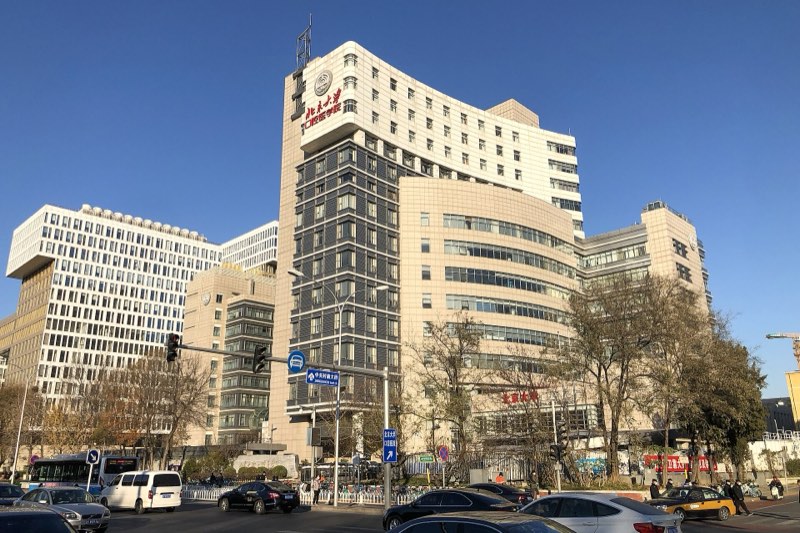
- Beijing: Peking University School and Hospital of Stomatology (北京大学口腔医院). A Grade 3A dental hospital founded in 1941. Its International Clinical Division sits next to the main hospital, in Building B of the Beijing International Building at No. 18 Zhongguancun South Street, and offers full outpatient dental treatment in English. It does not admit inpatients.
- Shanghai: Shanghai Ninth People's Hospital (上海交通大学医学院附属第九人民医院). The designated institution for a National Center for Stomatology, with clinical stomatology and plastic surgery as national key disciplines. Its international service is at the Pudong campus, 1908 West Gaoke Road, which Shanghai's official international medical services directory lists with English service and direct billing with 14 insurers.
- Chengdu: West China Hospital of Stomatology, Sichuan University (四川大学华西口腔医院). Home to a National Center of Stomatology, it grew out of a dental clinic founded in 1907 and runs a 24-hour dental emergency service. Neither its Chinese nor its English site documents an international department, so bring an interpreter.
The finder above has each hospital's address in English and Chinese, a map, and links to its own pages.
How long do dental implants take, and do you need two trips?
Unless your dentist can place the implant and the tooth in one visit, plan for two trips, because the implant has to fuse with the jawbone before the crown goes on:
- Peking University Hospital of Stomatology's patient guide says the crown is made 2–3 months after the implant is placed.
- An NHS patient leaflet from Cambridge University Hospitals says healing in the bone usually takes three to six months, and a bone graft adds at least four months.
- The American Dental Association's MouthHealthy guide notes that some patients can have the implant and the replacement teeth placed in one visit, while others wait up to several months.
So plan a first trip for the examination and implant placement, and a second trip a few months later for the crown. Ask the dentist whether your case could be done in one visit, and whether you will leave with a temporary tooth.
How to book dental implants in China as a foreigner
- Collect your records. Ask your dentist for recent X-rays or 3D scans, a summary of your dental history, and a list of your medicines and health conditions.
- Contact the international clinic. In Beijing, write to the International Clinical Division of Peking University Hospital of Stomatology; in Shanghai, the Ninth People's Hospital's Pudong campus. Send your records and ask for a treatment plan and a written estimate.
- Book with your passport. Hospitals register foreign patients by passport, and you will need it at every visit.
- Plan the trips around healing. Book the first trip for the examination and implant placement, and the second for the crown, using the healing time the dentist gives you.
- Pay as you go. Public hospitals usually ask you to pay before each stage of treatment. Keep every itemized receipt for your insurer.
If you would rather not arrange this yourself, our coordinators can book the hospital, go with you to appointments and interpret.
What to ask before you commit
- Which implant system and which crown material? The brand and material change the price, and you need to know them for any repair at home.
- What exactly does the estimate include? Check whether it covers the examination and scans, the implant, the abutment, the crown, bone grafting if needed, and follow-up visits.
- Who places the implant? Ask for the dentist's name and department.
- What happens if something goes wrong after you fly home? Agree a plan with both the hospital and your dentist at home, and ask for English copies of all your records and scans before you leave.
Risks and aftercare at home
Implants need healthy gums and enough bone, and complications such as infection or a failed implant can appear weeks after placement, when you may already be home. Before you travel, ask your own dentist whether they will look after an implant placed abroad, and bring your records back with you. See the risks section of our medical tourism in China guide for planning around surgery abroad.