Shenzhen medical tourism mostly means one hospital: The University of Hong Kong-Shenzhen Hospital (HKU-SZH), a public hospital run by the University of Hong Kong, with an International Medical Center that works in English. It is a short trip from Hong Kong, publishes package prices for 67 operations, and is the national pilot hospital for using drugs approved in Hong Kong but not yet on the mainland. This guide covers what HKU-SZH offers foreign patients, how to get there, the visa you need, costs and payment.
Shenzhen drew extra attention in November 2026, when it hosted the APEC Economic Leaders' Meeting. For patients, what matters is simpler: a Hong Kong-run hospital on the mainland side of the border.
Is Shenzhen a good place for medical treatment?
It suits three kinds of patient:
- People who want a Hong Kong-style hospital at mainland prices. HKU-SZH opened in July 2012, is a Grade 3A general hospital, and passed full-organisation accreditation by the Australian Council on Healthcare Standards (ACHS) in 2015, according to the hospital's January 2026 report. The same report says it has treated patients from 129 countries and regions.
- People already in Hong Kong. High-speed trains reach Shenzhen's Futian station from Hong Kong West Kowloon in about 15 minutes, so a check-up or a second opinion fits easily into a Hong Kong trip.
- People who need a drug or device approved in Hong Kong. Under the Greater Bay Area's "Hong Kong and Macao Drug and Device Connect" pilot, HKU-SZH can use some medicines and devices that are listed in Hong Kong or Macao but not yet registered on the mainland (more below).
For the widest choice of national-level specialists, Beijing and Shanghai still lead, and neighbouring Guangzhou has Sun Yat-sen University Cancer Center and the Zhongshan Ophthalmic Center. Compare them all in our hospital finder.
The University of Hong Kong-Shenzhen Hospital
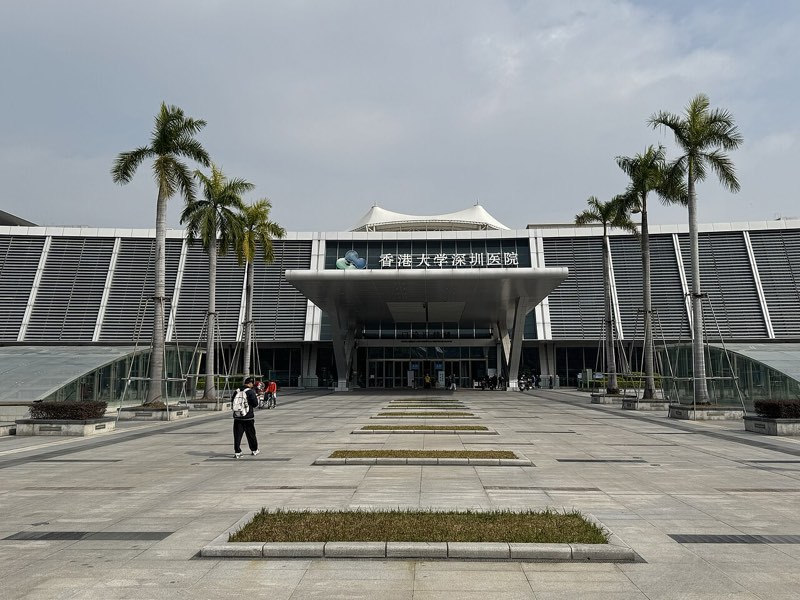
HKU-SZH is a 2,000-bed teaching hospital of the University of Hong Kong, built and funded by the Shenzhen government. Its International Medical Center (国际医疗中心, IMC), in Building V, has been open since the hospital started. According to the hospital's own description, the IMC offers:
- Outpatient care, inpatient care and health check-ups, by a team of Hong Kong professors and senior mainland doctors, with one-to-one bilingual service.
- Signs, test instructions and billing notes in Chinese and English throughout the center.
- Its own endoscopy, CT and MRI, and single rooms and suites for inpatients.
- Direct billing with more than 30 high-end health insurers, Chinese and international.
Across the hospital there is also a bilingual phone line, lab reports in Chinese and English, an English WeChat service, English patient guides and foreign-currency exchange machines.
The hospital's four flagship centers are orthopaedics, cardiovascular medicine, oncology, and reproductive and prenatal medicine. The hospital says spine surgery is one of the departments foreign patients use most, with complex spinal deformity patients from Italy, Russia and Indonesia.
It also publishes per-case package prices for 67 types of surgery, unusual for a Chinese public hospital, so you can know the price of many operations before you fly. Our HKU-Shenzhen Hospital guide has the booking steps and a printable Chinese address for your driver.
Drugs approved in Hong Kong: the Drug and Device Connect pilot
In September 2020, eight national agencies named HKU-SZH the first pilot hospital for the Greater Bay Area scheme known in Chinese as 港澳药械通. It lets the hospital use drugs and medical devices that are urgently needed, already on the market in Hong Kong or Macao, not registered by China's National Medical Products Administration, and with no registered substitute on the mainland. By September 2026 the hospital had been approved to use 44 drugs and 21 devices under the scheme, according to its own page on the pilot.
Whether one of them is right for you is the treating doctor's decision, case by case. If you are looking for a drug that is not available in mainland China, send the drug name with your records and ask before you travel. For drugs approved elsewhere abroad, Hainan's Boao Lecheng pilot zone runs a similar program.
Getting to HKU-SZH from Hong Kong
- High-speed rail: trains from Hong Kong West Kowloon reach Futian station in about 15 minutes (MTR trip planner). You clear mainland immigration at West Kowloon before boarding, so you need your visa first.
- By land through Futian Port: the hospital's transport guide lists Express Bus 37 (高快巴士37号) from the Futian Port bus terminus to the hospital.
- By metro inside Shenzhen: take Line 9 to Shenzhen Bay Park station, exit D1, then walk about 5 minutes; or Line 1 to Qiaocheng East, exit C1, then walk about 10 minutes.
The hospital is at 1 Haiyuan 1st Road, Futian District (广东省深圳市福田区海园一路1号).
Do you need a visa for treatment in Shenzhen?
Yes, for planned treatment. Shenzhen follows the same entry rules as the rest of mainland China: the 240-hour visa-free transit and the 30-day visa-free entry for many passports cover tourism, business, visits and transit, not medical treatment, as our guide to medical tourism in China explains with the official sources. Apply for a Chinese visa and ask the hospital for an invitation letter.
Shenzhen's Luohu, Huanggang, Shekou and airport checkpoints do issue port visas on arrival, but Shenzhen's government describes them as being for foreigners with an urgent need to enter who could not get a visa in time. Don't plan a treatment trip around one.
Hainan is the one place in China where visa-free entry explicitly allows medical treatment.
Costs and payment in Shenzhen
Consultation fees at Guangdong's public hospitals are capped by the province: see how much it costs to see a doctor in China. International medical centers set their own, higher prices, so ask the IMC for a written estimate, and for surgery, ask for the package price and what it leaves out. Health check-up prices for comparison are on our health check-ups in China page.
To pay, link your Visa or Mastercard to Alipay or WeChat Pay before you travel, carry some cash, and keep every itemised receipt. If your insurer is one of the IMC's direct-billing partners, confirm cover and get a guarantee of payment before admission.
How to book
- Phone the International Medical Center (+86 755 8691 3388), or contact the hospital's general enquiry line (+86 755 8691 3333, info@hku-szh.org).
- Send your diagnosis, recent scans and medication list, and ask for a written plan, price and expected length of stay.
- Apply for your visa with the hospital's invitation letter.
- Bring your passport to every visit; the hospital registers foreign patients with it.
If you would rather not handle this yourself, our coordinators can contact the hospital, get the written estimate, book the appointment and go with you to interpret.